
FPGA-Based Highly Parallel Architecture
Enabling real-time autonomous control for mobile agents in dynamic environments
Overview
Japan faces a severe driver shortage, with 36% of logistics demand potentially stagnating by 2030. While AGVs are a key solution, conventional path planning faces computational bottlenecks and high costs for proximity sensors.
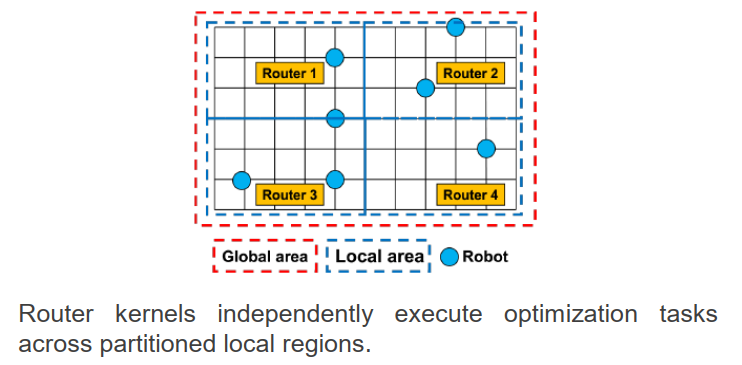
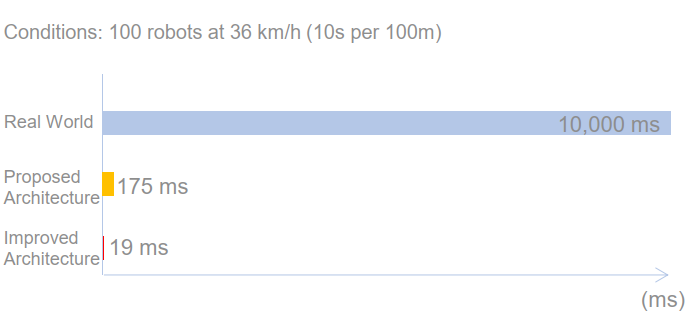
This technology implements a proprietary NoC-inspired architecture on FPGA, replacing "global batch computation" with "highly parallel local region processing." By dividing the domain into areas managed by router kernels, the system emulates agent movements significantly faster than real-time. This allows pre-emptive collision and deadlock detection, enabling safe, low-cost, real-time autonomous control in large-scale environments with minimal sensor dependency.
Significantly faster than real-world movement
Product Application
Enables autonomous control for diverse multi-agent systems:
□Logistics : Real-time routing for thousands of AGVs, maximizing throughput via pre-emptive collision and deadlock prevention.
□Autonomous Driving : Pre-emptively predicting collision risks with other vehicles or obstacles to instantly generate safe avoidance paths.
□Drones : Autonomous obstacle avoidance for rapid aerial delivery by large-scale swarms.
Related Works
[1] DOI: 10.1109/MCSOC67473.2025.00021
IP Data
IP No. : JP2025-188343
Inventor : Waidyasooriya Hasitha Muthumala, Masanori Hariyama
keyword : FPGA, Mobile Agents, Autonomous Control, Network-on-Chip, High-Speed Computing, AGV, Autonomous Driving