
Mood State Assessment and Prediction Model Using Multimodal Data
Applications in Bipolar Disorder Treatment and Early Detection of Depressive States
Overview
In treating bipolar disorder, patients must be aware of their mood fluctuations and maintain a regular lifestyle. Hypomanic states are difficult to distinguish from remission and may lead to treatment discontinuation; accurate mood monitoring is therefore essential. In the general population, early detection of depression and bipolar disorder is also important, and tracking mood variability may contribute to improvements in social functioning and interpersonal relationships.
This invention is a model that evaluates current mood states and predicts future mood based on multimodal daily health data. An app implementing this model serves as a tool that enables users to objectively monitor their mood state (manic, normal, or depressive) without subjective self-reporting burden. Expected applications span a wide range of use cases, including treatment support and relapse prevention for bipolar disorder patients, early detection of manic and depressive episodes, and performance enhancement in healthy individuals.
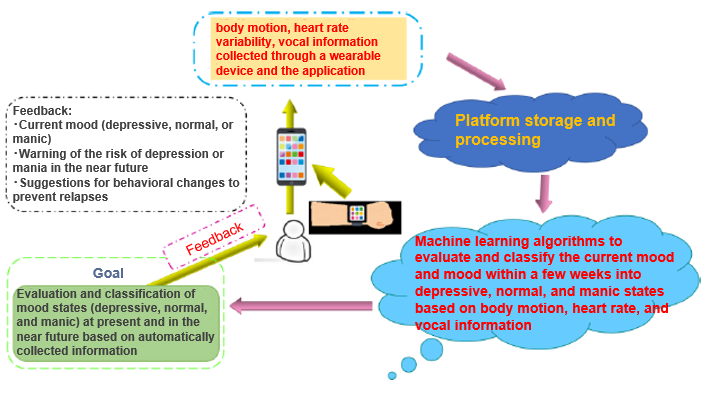
Methods for Model Development
【Clinical Trial Conditions】Participants: 113 patients with bipolar disorder and 97 healthy individuals Duration: 6 or 9 months
Methods: Collection of (1) activity data including step count and distance traveled, (2) sleep data, (3) heart rate data, and (4) voice data, alongside self-reported mood state records.
Mood prediction models were developed from each data type to assess concurrent mood states and predict mood states one week ahead.
Results: Successfully developed robust multimodal ML models achieving AUC values up to 0.80 for future state prediction.
Product Application
・Treatment support and relapse prevention tool for patients with bipolar disorder (SaMD)
・Early detection tool for manic and depressive episodes
・Mental health care tool for the general population
Related Works
[1] Li X. et al., Calculation of approximate heart rate variability indicators based on low-resolution heart rate data provided by widely used commercially available wearable devices. Biomedical Signal Processing and Control. 112, 108579 (2026) DOI: 10.1016/j.bspc.2025.108579
IP Data
IP No. : WO/2026/084039
Inventor : TOMITA Hiroaki, LI Xue, ITO Akinori
keyword : bipolar disorder, manic-depressive, Programmed Medical Devices, Digital Therapy, Emotion Prediction