
Scanning control technology for designing desired laser intensity distributions
Precise design of scanning speeds and trajectories, contributing to enhanced microparticle control and improved fabrication accuracy
Overview
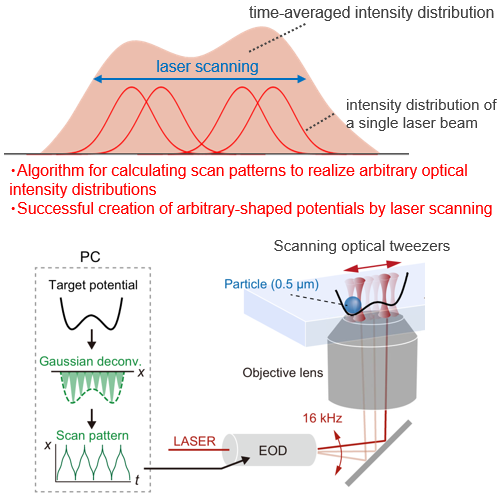
In conventional laser scanning control, it is difficult to accurately match an arbitrary target intensity distribution even when optimizing the temporal change of irradiation positions. This has imposed limits on the precision of microparticle control using optical tweezers and the resolution of drawing and fabrication. This invention overcomes these constraints by reverse-calculating and optimizing scan patterns from target distribution data. By precisely managing irradiation timing and intensity balance, it aligns actual laser intensities with ideal profiles, enabling high-precision microparticle manipulation, maskless lithography, and optical 3D printing.
Leveraging this technology, inventors achieved the world’s first experimental demonstration of particle transport with minimal thermodynamic dissipation, as predicted by mathematical "optimal transport theory". This breakthrough provides a foundation for next-generation ultra-low-power information processing and the design of precision nanomachines
Scanning a laser at high speed to create an arbitrary-shaped potential
Product Application
・Maskless exposure system
・Stereolithography (SLA) 3D printer
・Next-generation ultra-low-power computing device
Related Works
Nature Communications volume 16, Article number: 10424 (2025)
DOI:10.1038/s41467-025-66519-9
IP Data
IP No. : JP 2026-36588 A
Inventor : TOYABE Shoichi, NAKAYAMA Yohei, OIKAWA Shingo, SAGAWA Takahiro, ITO Sosuke,
keyword : optical tweezers, Maskless exposure system, stereolithography (SLA) 3D printer, "optimal transport theory