
Passive DC Circuit Breaker
Arc-free, reliable interruption that eliminates shutdown failure, arc damage, noise and space problems.
Overview
Conventional DC circuit breakers interrupt short-circuit faults by opening their contacts and generating an
explosive arc. But the current may rise faster than it can be limited, and interruption sometimes fails. The
arc damages the breaker and nearby equipment and generates noise, and their large size makes installation
sites hard to secure.
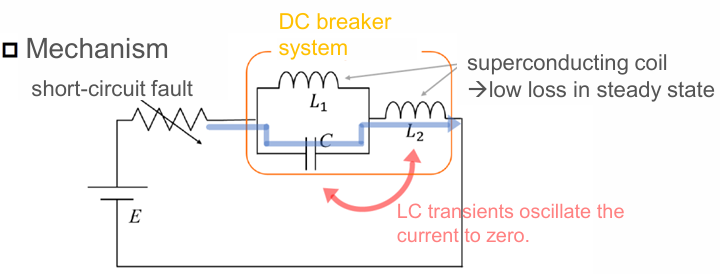
This invention combines a superconducting coil and a capacitor to make the fault current oscillate and
create a point where the current becomes zero, at which the contacts open. Powered by the fault current
itself, it needs no supply for detection, control or driving (passive), and interrupts reliably without an
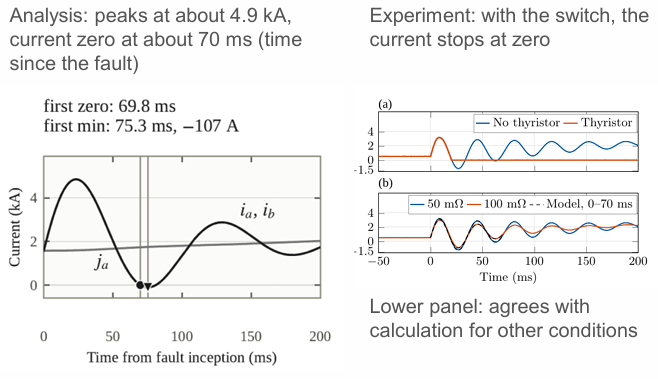
arc. For 1.5-kV railway DC power supply, the required coil size has been determined numerically for each
supply area (urban 130–145 mH, suburban 565–680 mH, rural 230–235 mH), together with the condition for the
current to reach zero. Experiments confirm the current reaches zero and can be interrupted there.
Passive current limiting and shutdown
Product Application
・Railways (DC traction power supply)
・DC distribution and microgrids
・DC systems for renewable energy (e.g. solar, wind power)
・DC power supply for data centers and factories
・EV fast-charging facilities, ships and other mobile objects
Related Works
[1] H. Sasaki, K. Nishiyama, Y. Nagasaki, M. Tsuda, the 2026 Annual Meeting of the Institute of Electrical Engineers of Japan (March 2026, Sendai, Japan). [2] Y. Nagasaki, H. Sasaki, S. Okumura, M. Tsuda, "Minimum Inductance and Its Existence Limits for Passive LC Current-Zero Formation in Two-End-Fed DC Railway Feeders," IEEE Trans. Transp. Electrif. (submitted)
IP Data
IP No. : WO2023/144885
Inventor : NISHIYAMA Kanako, NAGASAKI Yoh, TSUDA Makoto
keyword : DC circuit breaker, Passive circuit breaker, Arc-free, Superconducting, Short-circuit fault
protection, DC power supply system