
Method for producing Proton-containing oxides
To enrich the variety of ceramic materials developed that contain protons.
Overview
Research and development of high-proton-conducting oxides, which are stable at intermediate temperatures around 300 ~ 600°C, have been carried out for practical applications in electrochemical devices such as fuel cells. However, since most of the existing materials are synthesized through high-temperature sintering, they are limited to perovskite-type or related crystal systems or specific material systems, and the degree of freedom of crystal structure and composition is limited, which limits the development of practical materials.
The present invention relates to a manufacturing technique for obtaining a proton-containing oxide by introducing a proton into an oxide by reacting a basic oxide with a carboxylic acid melt. According to this method, it is possible to introduce a proton into various ceramics, which are conventionally difficult to examine, and the range of material selection can be expanded. The present invention, which does not select the shape of the raw material, is expected to be applicable to components such as electrochemical devices, and contributes to the practical application of proton-conducting oxides.
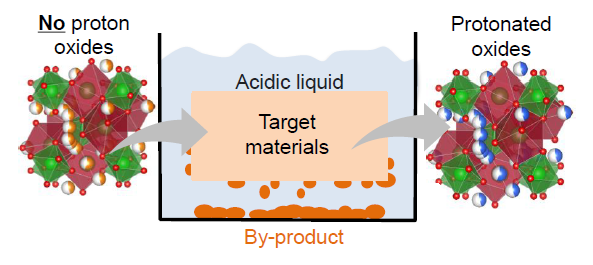
Example for oxide with proton
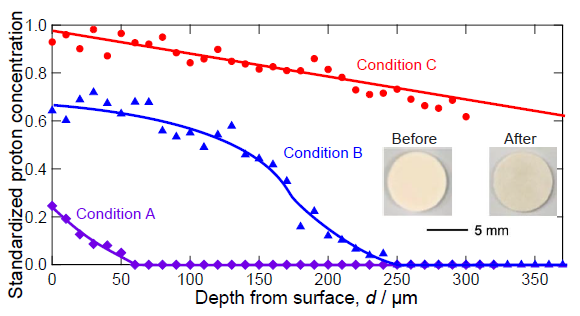
Product Application
・Water electrolysis cells
・Fuel cells
・Hydrogen sensors
Related Works
[1] Akihiro Ishii, et al., Proton conductivity of Li+–H+ exchanged Li7La3Zr2O12 dense membranes prepared by molten long-chain saturated fatty acids, Mater. Adv., 2024, 5, 1531-1539
IP Data
IP No. : JP7819970、US 2025/0214860
Inventor : ISHII Akihiro, TAKAMURA Hitoshi, KUME Daisuke
keyword : FuelCell, HydrogenSensor, WaterElectrolysis, ProtonConductor